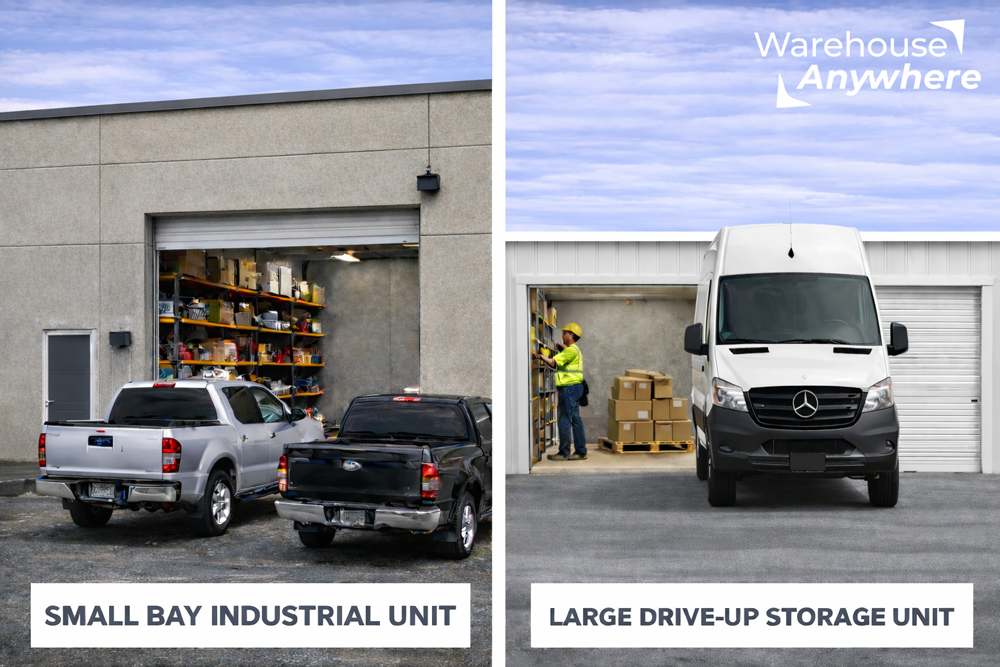
While oversized distribution centers sit half-empty and office parks struggle to fill desks, small bay industrial space is booming. Vacancies are at record lows. Rents are climbing. And businesses across nearly every industry are competing to lock up units before they’re gone.
So what exactly is small bay industrial? Why is demand so relentless? And is it the right space for your business? This is the most comprehensive guide to small bay industrial space written specifically for business owners and operators.
What Is Small Bay Industrial?
Small bay industrial properties are multi-tenant properties with small footprints that can vary in size from 5,000 square feet to 200,000 square feet and will typically offer small bay industrial units for lease ranging from 1,000 square feet to 10,000 square feet. These small bay light industrial spaces provide warehouse space, drive-in loading access, and fixed office buildouts within a single unit, designed for tenants using small bay industrial space for local service companies, light manufacturing, e-commerce fulfillment, and last-mile distribution. All small bay industrial spaces experience high demand, low vacancy rates, and offer tremendous flexibility for tenants who are growing their businesses.
To put it simply, a small bay industrial unit is the actual size your business needs to operate — not a place to store things, not a workspace that can’t hold a pallet, and not a 50,000 square foot building you might grow into a decade from now. A small bay industrial unit is a real commercial space with a loading door, high ceilings, a functional floor, and an office, all sized appropriately for the current scale of your business with plenty of room to grow.
Small bay industrial is more than a niche category. It accounts for nearly one-third of all industrial real estate in the US and provides essential support to well over 100,000 American businesses. A typical small bay industrial building houses 20 to 100 separate tenant businesses, each operating independently behind their own loading door as though it were their own standalone building. The infrastructure costs of these shared small bay industrial properties — parking, loading aprons, and utilities — are distributed across all tenants in the building, significantly reducing total occupancy costs compared to a standalone building of a similar size.
The term small bay industrial is sometimes used interchangeably with small bay light industrial, flex industrial, or multi-tenant industrial. All of these terms describe the same product type.
What About Micro Bay Industrial?
Within the small bay category sits an even more compact product type: micro bay industrial. Micro bay units are typically under 5,000 square feet, often in the 1,000 to 3,000 square foot range, with tighter column spacing and the same core features: grade-level doors, warehouse floor, small office, and a multi-tenant building. They are purpose-scaled for businesses at the earliest stages of growth.
If small bay is for businesses that have outgrown their garage, micro bay is one step past the garage. A real commercial address, a proper loading door, and a functional workspace without committing to more square footage than you can use. A 2,000 square foot micro bay unit at $1.00 to $1.25 per square foot per month runs $2,000 to $2,500 monthly, which is often less than comparable office space and far more functional for an operational business.
What Does a Small Bay Industrial Unit Look Like?
The Warehouse/Bay Area
- Ceiling heights of 12 to 24 feet (18 to 24 feet in newer buildings)
- Grade-level roll-up loading doors, typically 12 to 14 feet wide. Unlike large distribution centers that use dock-high doors built for 53-foot semi-trucks, small bay units use ground-level doors that work for any vehicle: cargo vans, box trucks, forklifts, and flatbed trailers. This is a practical advantage most service and trade businesses use every single day.
- Concrete tilt-up or metal construction for durability, low maintenance, and predictable operating costs
- Polished concrete floors rated for heavy equipment and vehicle traffic
- Three-phase electrical service in most units
- Higher parking ratios than standard industrial, built for employees, service vehicles, and customer visits
The Office Buildout
Most units include an office component ranging from 5-10% of total square footage in warehouse-heavy configurations, up to 25-50% in more office-forward flex units. Expect a private workspace, bathroom, and separate HVAC. Some units include a customer-facing entrance or small showroom area. Tenants can also add mezzanine levels above the office for additional storage or workspace.
Who Uses Small Bay Industrial Space?
Small bay industrial attracts a wide range of businesses. If your operation involves storage, production, distribution, or hands-on service work, this space was built for you.
Contractors and Trades – HVAC, plumbing, electrical, and general contractors store equipment, park service vehicles, and stage jobs. Drive-in doors and paved yards make equipment movement easy.
Light Manufacturing and Fabrication – Custom furniture makers, metal fabricators, sign shops, and print shops use the open floor and high ceilings for production equipment.
Last-Mile Distributors – Regional logistics companies use small bay units as local hubs, receiving freight, breaking down pallets, and dispatching to local customers.
E-Commerce Fulfillment – When online businesses outgrow home operations, small bay is the natural next step: a real loading door, room for inventory and packing, and proper freight access.
Auto-Related Businesses – Auto detailers, tint shops, upholstery specialists, and specialty repair operations gravitate toward drive-in bays and durable floors.
Tech Startups and R&D Firms – Robotics, drone technology, and AI hardware teams use small bay for prototyping, light assembly, and system testing. Shorter lease terms work well for businesses scaling quickly as their technology matures.
Hybrid Retailers and Showroom Businesses – Businesses that sell direct to customers but also need back-end storage use small bay units to combine a customer-facing showroom with functional warehouse space, all under one lease.
Startup and Early-Stage Businesses – Micro bay units serve as the natural starter space for new businesses graduating from home-based operations. Many of today’s larger tenants started in a micro bay unit and expanded from there.
Service Businesses – Pest control, cleaning services, and landscaping operations use small bay units as dispatch points for vehicles, supplies, and admin work.
Small Bay Industrial vs. Other Space Types
| Feature | Micro Bay | Small Bay | Mid-Bay | Large Bay |
|---|---|---|---|---|
| Unit size | 1,000 to 5,000 sq ft | 5,000 to 50,000 sq ft | 25,000 to 150,000 sq ft | 100,000+ sq ft |
| Clear height | 12 to 16 ft | 14 to 20 ft | 24 to 32 ft | 32 to 40 ft |
| Tenancy | Multi-tenant | Multi-tenant | Single or multi | Single tenant |
| Loading | Grade-level doors | Grade-level doors | Dock-high + grade | Dock-high only |
| Office ratio | 10 to 50% | 5 to 50% | 2 to 10% | Minimal |
| Lease term | 1 to 3 years | 1 to 5 years | 3 to 7 years | 5 to 15 years |
| Typical rent (NNN) | $0.75 to $1.25/sq ft/mo | $0.40 to $0.65/sq ft/mo | $0.55 to $0.85/sq ft/mo | $0.75 to $1.20/sq ft/mo |
| Best for | Startups, contractors, artisans | Service businesses, light mfg, last-mile | Regional distribution, 3PL | Major distribution, automation |
| Vacancy (2025-26) | ~3 to 4% | ~3 to 4% | ~5 to 6% | ~6 to 8% |
The grade-level door distinction matters more than most tenants realize. Large distribution centers use dock-high loading, raised platforms built specifically for 53-foot semi-trucks. If your business doesn’t ship full truckload freight, dock-high doors are more of an inconvenience than an asset. Grade-level doors work for everything from a cargo van to a flatbed trailer.
Why Small Bay Industrial Is Booming Right Now
Big Warehouses Overbuilt. Small Bay Didn’t.
Between 2020 and today, developers poured 1.8 billion square feet of large-scale industrial space into the US market, according to Matthews Real Estate. That’s not a typo. 1.8 billion square feet, driven by pandemic e-commerce demand and cheap borrowing. When that demand normalized, all that space had to go somewhere, and it didn’t. Big-box vacancy climbed to 6-8% nationally and is still moving in the wrong direction in a lot of markets.
Small bay never had that problem. Vacancy stayed in the 3-4% range throughout, and that gap tells you everything. Different buildings, different tenants, different story.
There Is Barely Any New Small Bay Being Built
According to CoStar data cited by Matthews Real Estate, only 13% of the industrial space under construction in the US is under 200,000 square feet. The rest is large-format. So why aren’t more developers building small bay? Because it costs too much.
A small bay building runs around $142 per square foot to build, up 17% from just a year ago. A comparable big-box warehouse runs about $75. The difference comes down to complexity. Small bay buildings need more of everything: more demising walls, more plumbing runs, more electrical drops, more individual loading doors. When you are carving a building into 20 to 100 separate tenant spaces instead of one big open floor, the costs stack up fast. Throw in expensive infill land and a lot of developers simply walk away. The result is national availability for small bay space sitting at approximately 3.4%, with new supply growing at less than 0.5% per year in a market where demand keeps climbing.
Small Bay Tenants Are Not Going Anywhere
Here is something worth understanding about who actually rents small bay industrial space. It is not Amazon. It is not a national logistics company making location decisions based on global shipping lanes. It is your local HVAC contractor, your regional parts distributor, the cabinet maker two miles from your house. These businesses are not going to relocate because of a trade war or a shift in consumer behavior. They are here because their customers are here.
That local demand base is what makes small bay so stable. A few things are making it even stronger right now. The skilled trades are booming, which means more independent contractors and service businesses that all need a place to operate. Manufacturing reshoring is filling small bay units with machine shops, fabricators, and assembly operations. And record small business formation since 2020 has created a constant flow of first-time tenants looking for exactly this kind of space.
Finding Affordable Space Is Getting Harder
Almost all new small bay development being built today is Class A product at Class A rents. That means smaller businesses are being pushed into an already tight pool of Class B and C inventory and competing harder for it. Rents are going up. Good units in good locations get leased quickly. If you find something that works for your business, waiting around to see if something better comes along usually does not pay off.
What to Expect When Leasing a Small Bay Industrial Unit
Most small bay industrial leases are triple-net (NNN), meaning you pay base rent plus a proportionate share of property taxes, insurance, and CAM costs. Add 15-25% to base rent when estimating your true monthly cost.
Typical terms: 1 to 5 years with annual escalations of 2-4%. Shorter terms than large industrial is a feature worth appreciating. You are not locked into a space that no longer fits your operation as you grow.
Usually included: Shell space, office buildout, common area maintenance, water and sewer.
Usually your responsibility: Electricity, gas, internet, interior maintenance, and commercial liability insurance.
How to Find the Right Small Bay Industrial Unit
Define your requirements first. Minimum square footage, ceiling height needs, loading door type, power requirements, office needs, and parking for employee vehicles and fleet trucks.
Set a realistic budget. Use the rate table above as your baseline and add 15-25% for NNN expenses. Size your unit honestly. A micro bay unit at a higher per-square-foot rate is almost always more cost-effective than leasing a larger unit and leaving half of it empty.
Evaluate location carefully. For most tenants, three things matter most: proximity to customers or job sites, access to highways, and employee commute. A great unit in the wrong location will cost more in time and fuel than any rent savings.
Tour at least three to five properties and evaluate each on ceiling height and column spacing, loading door condition and apron space, office buildout quality, security infrastructure, shared amenities, parking, and neighboring tenants. A building full of well-run trade businesses can be a source of referrals. High turnover and inconsistent operations next door will be a daily headache.
Review the lease carefully. Key items to check: permitted use clause, renewal options, rent caps, HVAC maintenance responsibility, and subletting rights. A tenant representative broker is paid by the landlord at no cost to you and can save significant time and money during negotiations.
Frequently Asked Questions
What is the difference between small bay industrial and light industrial?
Light industrial refers to the zoning category covering production, assembly, storage, and distribution with minimal environmental impact. Small bay industrial is a specific building type within that category. All small bay industrial space is light industrial, but not all light industrial space is small bay.
Can I run any type of business in a small bay industrial unit?
Most properties allow a wide range of uses, but zoning and lease terms govern what is permitted. Heavy manufacturing, hazardous materials, and food production typically require special permits or may be restricted. Always verify your intended use with the landlord and local zoning authority before signing.
Is there much competition for available units?
Yes, and it is increasing. In most US markets, well-located small bay units at reasonable rents do not stay available for long. If a unit fits your needs and budget, hesitation tends to be costly.
What size unit do I need?
Add up the square footage of everything you need to store or operate, including equipment, inventory, vehicles, and workstations, then add 20 to 30 percent for circulation space. When in doubt, slightly oversizing is smarter than undersizing. Most businesses grow into extra space faster than they expect.
What if my space needs change during my lease?
Most small bay leases run 1 to 5 years, giving you more flexibility than large industrial. Negotiate renewal options and, where possible, rights of first refusal on adjacent units in the same building.
What if I need storage but am not ready for a full small bay unit?
Warehouse Anywhere offers secure, large storage units for businesses that need reliable, accessible storage before committing to a full industrial unit. Available sizes include 10×20 (200 sq ft), 10×30 (300 sq ft), 20×20 (400 sq ft), and 20×30 (600 sq ft). Contact Warehouse Anywhere to learn more about storage options and available small bay industrial locations near you.
Warehouse Anywhere specializes in small bay and light industrial properties across the US. Contact our team to get the full list of available small bay industrial locations near you.
Not quite ready for a full bay unit? Warehouse Anywhere also offers secure, large storage units in four sizes: 10×20 (200 sq ft), 10×30 (300 sq ft), 20×20 (400 sq ft), and 20×30 (600 sq ft), ideal for businesses that need reliable, accessible storage before making the jump to a full industrial unit. Explore storage options