Running a restaurant is a constant battle for space. Every square foot of your location is either generating revenue or costing you money, which means storage is almost always the last thing to get priority and the first thing to create problems when it runs out.
Whether you operate a single location, manage a regional chain, or oversee a franchise system, the same challenge applies: you need enough storage to keep operations running smoothly without sacrificing the floor space that pays the bills. Getting that balance right requires a clear understanding of what needs to be stored, where it belongs, and when offsite storage for restaurants makes more sense than trying to squeeze everything under one roof.
This guide covers all of it.
The Two-Part Framework Every Restaurant Operator Needs
Effective restaurant storage comes down to two categories: on-site storage and offsite storage. Most operators focus almost entirely on the first and underutilize the second. The businesses that get this right treat both as essential parts of the same system.
On-site storage covers everything your team needs daily access to: ingredients, supplies, smallwares, and equipment in active rotation. This space needs to be organized, compliant with health codes, and designed around your kitchen workflow. It lives in your building and has to earn its place in a footprint where every square foot matters.
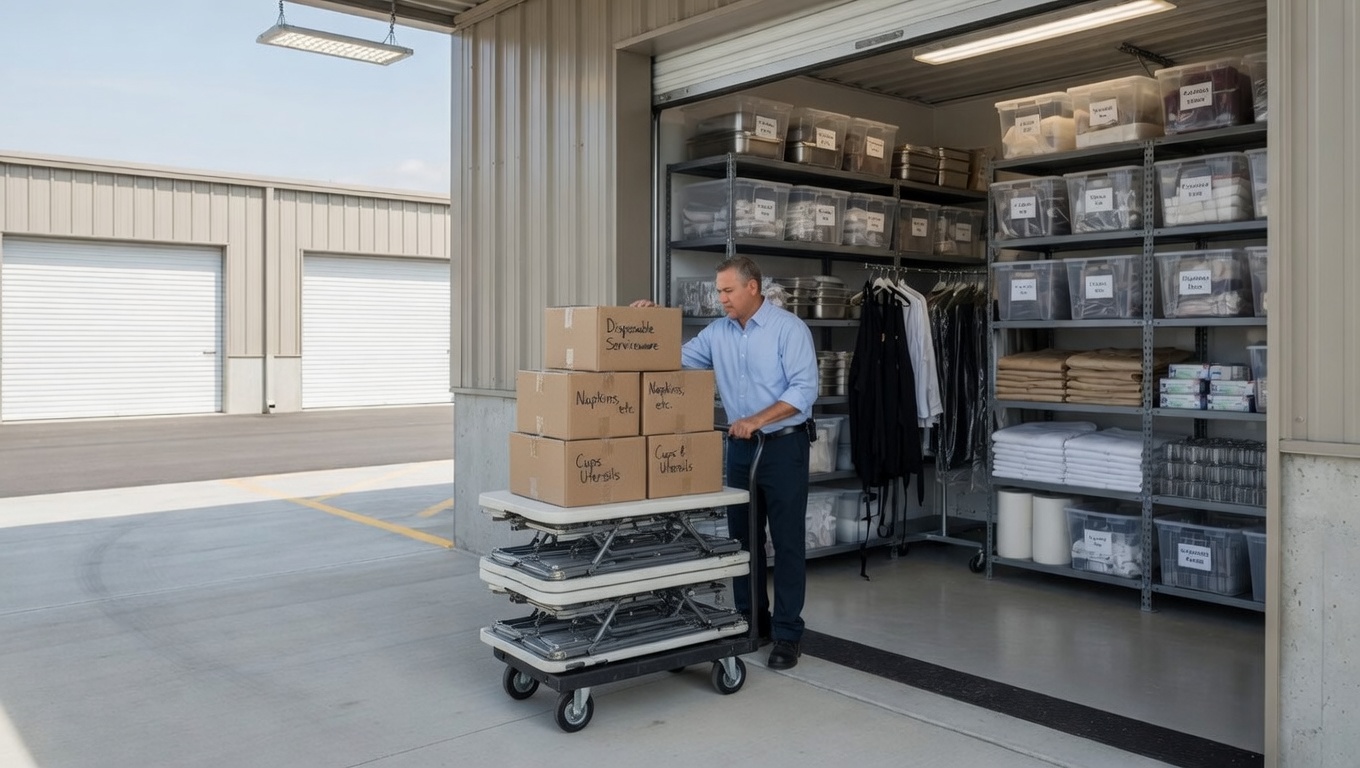
Offsite storage for restaurants covers everything else: large orders of dry goods purchased at volume, seasonal equipment and decorations, catering gear that is not used every day, furniture and fixtures during renovations, and backup inventory that would otherwise crowd your kitchen. A secure, weather-proof, drive-up accessible offsite storage unit keeps these items organized and accessible without letting them eat into your operational space.
Most storage problems in restaurant operations come from trying to handle both categories in the same location. When large inventory orders crowd the dry storage room and seasonal furniture fills the back hallway, the whole operation pays for it.
A note on portable storage containers: some operators use drop-off containers placed in their parking lot as a temporary overflow solution. These work for short-term situations like a renovation or a seasonal surge, but they are not a substitute for a professionally managed offsite storage facility. A fixed commercial storage unit offers better security, more consistent access, proper drive aisles for loading and unloading, and the kind of access management and operational oversight that a container sitting in a parking lot simply cannot provide. For restaurant operators running serious operations, the distinction matters.
On-Site Restaurant Storage Solutions
On-site storage is non-negotiable. Your kitchen needs immediate access to ingredients, your staff needs organized supplies, and your operation needs to meet health department requirements at every inspection. Here is how to think about each zone.
Dry Storage
Dry storage is where non-perishable ingredients, paper goods, cleaning supplies, and packaged items live. The basics are straightforward but often overlooked in busy operations.
Dry storage should be kept between 50 and 70 degrees Fahrenheit with humidity below 60%. Shelving should keep all items at least six inches off the floor and away from walls to allow airflow and prevent pest harborage. First-in, first-out (FIFO) rotation is not optional — it is the difference between consistent food quality and avoidable waste.
The most common dry storage mistake is using this space as a catch-all. Cleaning chemicals stored near food items, oversized orders crowding the shelves, or seasonal equipment taking up floor space all compromise the function of this zone. If your dry storage room is doing double duty, it is time to look at offsite options for the overflow.
Cold Storage
Refrigerated storage is one of the most operationally critical and health-code sensitive areas in any restaurant. Walk-in coolers should be maintained between 35 and 38 degrees Fahrenheit, with clear zone organization separating raw proteins, produce, dairy, and prepared foods.
A few principles that separate well-run cold storage from the alternative: everything labeled and dated, nothing stored on the floor, raw proteins always below ready-to-eat items, and airflow never blocked by overstacking. These are not just best practices — they are the standard inspectors look for.
Freezer Storage
Freezer units should hold at a consistent 0 degrees Fahrenheit or below. Walk-in freezers work best when organized by category and usage frequency, with high-rotation items near the door and longer-term inventory toward the back.
One area where offsite storage for restaurants intersects with freezer management: when a location is running a limited-time menu, catering a large event, or managing a seasonal promotion, the volume of frozen inventory can spike well beyond what an on-site freezer can handle. Planning for that overflow in advance is far less expensive than the alternatives.
On-Site Equipment and Smallwares Storage
Active equipment — the tools, smallwares, and supplies your team uses every shift — needs a designated home that is close to the point of use and easy to keep organized. This includes sheet pans, hotel pans, prep tools, and cleaning equipment.
The rule here is simple: if your team uses it daily, it belongs on-site. If they use it monthly or seasonally, it is a candidate for offsite storage.
Offsite Storage for Restaurants: What It Is and When You Need It
Offsite restaurant storage refers to a secure, accessible storage unit located near your restaurant where you keep items that do not need to live in your building full time. Think of it as a professional extension of your operation — close enough to access when you need it, completely out of your way when you do not.
The best offsite storage locations for restaurants are weather-proof, secure, and designed for commercial operators. That means drive-up access so your team can pull a van or box truck directly to the unit, wide drive aisles that make loading and unloading fast, and extended access hours that work around restaurant schedules rather than forcing you to work around theirs.
For multi-location chains and franchise operators, access management tools add another layer of value: the ability to control exactly who on your team can access which storage locations. In an industry with high staff turnover, that kind of oversight is not a luxury. It is a standard operating requirement. When an employee leaves, you need to be able to update access immediately — not track down a set of physical keys.
Warehouse Anywhere’s restaurant and hospitality storage program is built around exactly these needs — nearby, secure, always accessible, and easy to manage at any scale.
Who Needs Offsite Restaurant Storage?
Offsite storage for restaurants makes sense for any operator dealing with one or more of the following:
- Large orders of dry goods and non-perishables purchased at volume pricing
- Seasonal equipment, decorations, or patio furniture that cycles in and out of use
- Catering gear, event supplies, or specialty equipment used for off-premise events
- Furniture, fixtures, and equipment during a renovation or remodel
- Backup smallwares and supplies for multi-location chains
- Grand opening inventory for new locations coming online
- Marketing materials, branded merchandise, and promotional items
- Supply distribution for franchise systems managing multiple locations
If any of these apply to your operation, you are likely either storing these items inefficiently on-site or absorbing costs you do not need to be absorbing.
What to Store Offsite: A Category-by-Category Breakdown
Dry Goods and Non-Perishable Inventory
Purchasing dry goods, paper products, cleaning supplies, and pantry staples in larger quantities is one of the most effective ways to manage supply costs across a restaurant operation. But those orders need somewhere to go that is not your kitchen hallway or dry storage room.
A dedicated offsite storage unit gives you an organized, accessible home for supply inventory. Items stay dry, protected, and ready to pull when your on-site stock runs low. For chain operations managing supply across multiple locations, a 20×20 or 20×30 unit provides enough space to run a centralized supply hub that feeds several restaurants from one storage location — a setup that works particularly well for growing franchise systems looking to standardize purchasing and distribution.
Seasonal Equipment and Decorations
Most restaurants operate seasonally in some form — holiday decorations, patio furniture, seasonal menu equipment, branded event signage, or promotional materials that come out a few times a year and then need somewhere to go. When these items do not have a dedicated home, they end up crowding the back of house and creating exactly the kind of clutter that slows operations down.
A 10×20 storage unit holds a full set of patio furniture, holiday decor, seasonal signage, and specialty equipment with room to spare. You access it when you need it and it never touches your operational space.
Catering and Event Equipment
Off-premise catering is a significant and growing revenue stream for many restaurant operations, but the equipment it requires — chafing dishes, serving platters, portable warming units, linens, event tents, tables, and specialty smallwares — is bulky and sits idle most of the time. Keeping it on-site means it is always in the way. Keeping it in a nearby, drive-up accessible offsite storage unit means it is organized, protected, and ready to load when an event is booked.
A 10×30 unit works well for most catering operations, giving you enough floor space to organize equipment by event type and stage full setups before loading a truck. For operators running a high volume of off-premise events, the ability to pull up, load out, and go without hunting through a cluttered back room is worth the storage cost many times over.
Renovation and Remodel Storage
Restaurant renovations are expensive and disruptive enough without the added problem of nowhere to put your furniture, fixtures, and equipment while the work is happening. Booths, chairs, tables, decorative fixtures, kitchen equipment, and smallwares all need to go somewhere during a remodel — and leaving them on-site creates safety hazards, slows the project down, and drives up contractor costs.
A 20×20 or 20×30 offsite storage unit handles the full contents of most single-location restaurant renovations. Items are secure, accessible, and out of everyone’s way until the work is done and you are ready to bring them back in. For chain operators managing rolling remodels across multiple locations, a dedicated storage unit at a central offsite location makes the whole program faster and less disruptive to the rest of the system.
Expansion and New Location Storage
Opening a new restaurant location involves a long runway of logistics: equipment arriving before the space is ready, furniture ordered in advance of opening, marketing materials and branded merchandise staged for launch. Without a dedicated place to hold this inventory, it ends up scattered across existing locations, sitting in lobbies, or stored in ways that create damage and loss before the doors even open.
A dedicated offsite storage unit near the new location gives your opening team a staging area that is organized, secure, and purpose-built for the job. For franchise systems opening multiple locations in a market, a centralized storage unit that feeds all new openings in the pipeline keeps the process consistent and controlled.
Multi-Location Chain and Franchise Supply Distribution
For operators managing multiple locations, offsite storage for restaurants becomes a logistics platform as much as a storage solution. Centralized supply distribution, system-wide equipment backup, and marketing material fulfillment all benefit from having a dedicated commercial storage location that serves the entire portfolio rather than duplicating storage costs at every individual site.
This is exactly the kind of operation Warehouse Anywhere is built for. Whether you are scaling a fast-growing regional concept or managing a mature franchise system, a 20×30 unit at a well-located facility gives you a professional, scalable supply hub that keeps every location stocked and every opening on schedule.
What Makes a Great Offsite Storage Location for Restaurants
Not all commercial storage is built for the way restaurant operations actually work. Here is what to look for when evaluating storage locations for restaurants near you.
Drive-up access. Your team needs to pull a cargo van or box truck directly to the unit door. A storage facility that requires carrying items through a lobby or down a hallway adds time and friction to every single run. Drive-up access is a baseline requirement for any working restaurant operation.
Wide drive aisles. Delivery vehicles, box trucks, and cargo vans need room to maneuver. Narrow drive aisles designed for passenger cars create real problems when you are loading out for a catering event or receiving a large supply order.
Extended access hours. Restaurants do not run on a 9-to-5 schedule and your storage should not either. Early morning supply runs, late-night returns from events, and weekend setups all require a facility that is accessible when your operation actually needs it.
Access management tools. For chain operators and franchise systems managing high-turnover teams, the ability to control who has access to which storage locations — and to update that access quickly when staff changes — is an operational necessity. Look for facilities that offer digital access management rather than physical keys that walk out the door with former employees.
Security. A commercial storage unit holding restaurant inventory, catering equipment, and supply assets needs a secure perimeter, access control, and video surveillance. The value of what you are storing warrants it.
Scalable unit sizes. Your storage needs will change as your operation grows. A provider that offers multiple unit sizes gives you the flexibility to right-size your storage at every stage without overpaying for space you do not need or running out of room when business picks up.
Choosing the Right Storage Unit Size for Your Restaurant
Warehouse Anywhere offers four commercial storage unit sizes designed to fit the full range of restaurant and hospitality storage needs:
10×20 (200 sq ft) — The right starting point for single-location operators managing seasonal equipment, event supplies, or supply overflow. Fits the contents of a fully loaded cargo van with room to stay organized.
10×30 (300 sq ft) — Works well for operators with active catering programs, larger seasonal inventories, or ongoing supply programs. Enough space to organize by category and stage full equipment setups before loading for an event.
20×20 (400 sq ft) — A strong fit for larger single-location operators or small chains managing backup equipment, renovation storage, or supply distribution across two to three locations.
20×30 (600 sq ft) — The right choice for multi-location chains and franchise operators. Functions as a centralized supply hub, grand opening staging area, or renovation storage solution for a full portfolio of locations.
Frequently Asked Questions
What is offsite storage for restaurants?
Offsite storage for restaurants refers to a secure, accessible commercial storage unit located near your restaurant where you keep items that do not need to live in your building full time. This includes seasonal equipment, catering gear, dry goods inventory, renovation furniture and fixtures, and multi-location supply inventory.
What should restaurants store offsite?
The best candidates for offsite restaurant storage are items used infrequently but needed reliably: seasonal decorations and equipment, catering and event supplies, large orders of non-perishable inventory, furniture and fixtures during renovations, grand opening inventory, and backup smallwares for chain and franchise operations.
How close should an offsite storage location be to my restaurant?
As close as practical. A storage unit within a 10 to 15 minute drive of your operation functions as a genuine extension of your back of house. Beyond 20 to 30 minutes, the friction of access starts to reduce the operational value.
What is the difference between portable storage containers and offsite storage units?
Portable storage containers are dropped off at your location — typically in a parking lot — and work well for short-term situations like a renovation or a one-time move. A fixed offsite storage unit at a professional facility offers better long-term security, consistent drive-up access with proper loading infrastructure, digital access management, and the operational reliability that a temporary container cannot provide. For restaurant operators with ongoing storage needs, a fixed commercial storage unit is the more practical and cost-effective solution.
What size storage unit does a restaurant need?
It depends on the volume and type of items you are storing. A 10×20 unit (200 sq ft) handles most single-location needs. A 10×30 (300 sq ft) works well for catering operations and active supply programs. Multi-location chains and franchise operators typically benefit from a 20×20 (400 sq ft) or 20×30 (600 sq ft) unit used as a centralized supply hub.
Is offsite storage cost-effective for restaurants?
In most cases, yes. The monthly cost of a commercial storage unit is typically far lower than the cost of additional square footage at your restaurant location, where every square foot carries the full weight of your rent, build-out costs, and overhead. When supply purchasing efficiency and operational time savings are factored in, offsite storage often pays for itself quickly.
How do I find storage locations for restaurants near me?
Warehouse Anywhere operates storage facilities across the US designed specifically for commercial operators. Visit our restaurant and hospitality storage page to find available locations near your operation and talk to our team about the right unit size for your needs.
Restaurant and franchise operators across the nation trust Warehouse Anywhere for secure, accessible, professionally managed offsite storage. From single-location operators managing seasonal overflow to multi-unit chains running centralized supply hubs, we have the unit sizes, locations, and service standards your operation requires. Find storage locations for restaurants near you or contact our team to get started.